When families begin looking for care for an aging parent or loved one, they often come across two common options: an Adult Family Home (AFH) and an Assisted Living Facility (ALF).
Both provide housing, meals, supervision, and assistance with daily living. However, they are different types of residential care settings, especially in terms of size, environment, living arrangements, and the overall experience.
If you are considering senior care in Washington State, understanding these differences can help you ask the right questions and find an environment that fits your loved one’s needs.
What Is an Adult Family Home (AFH)?
An Adult Family Home, commonly called an AFH, is a residential home licensed to provide personal care, room, meals, supervision, and other support to adults who need assistance with daily living.
In Washington State, an AFH generally serves a small number of residents in a residential home. Washington regulations allow an AFH to serve more than one and up to six adults, with some homes approved to serve up to eight residents.
Because of the smaller setting, an AFH can provide a more intimate, home-like environment.
Residents may receive assistance with activities such as:
- Bathing and personal hygiene
- Dressing
- Mobility
- Eating
- Toileting
- Medication routines
- Daily activities
- Housekeeping and laundry
- Social activities
Some Adult Family Homes may also provide specialized or nursing-related services, depending on their licensing, staffing, and residents’ needs.
What Is Assisted Living?
An Assisted Living Facility (ALF) is a larger residential care setting that provides housing, basic services, and assistance with activities of daily living.
In Washington State, assisted living facilities generally serve seven or more residents. They can range from relatively small facilities to much larger communities.
Depending on the facility, residents may have access to:
- Private or shared living arrangements
- Meals and snacks
- Personal care
- Housekeeping
- Laundry
- Social and recreational activities
- Transportation
- Medication assistance
- Certain nursing or specialized services
Some assisted living communities offer apartment-like units designed to provide residents with greater privacy and independence.
AFH vs. Assisted Living: What’s the Difference?
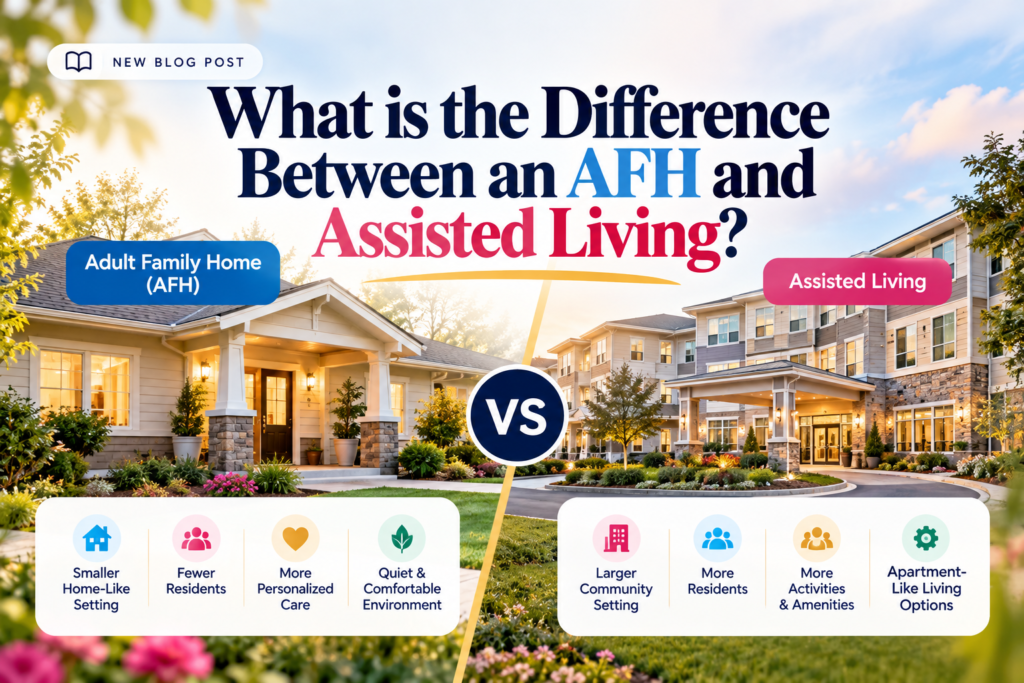
The biggest difference is often the size and style of the living environment.
| Feature | Adult Family Home | Assisted Living |
|---|---|---|
| Setting | Residential home | Larger residential community or facility |
| Typical size in Washington | 2–6 residents; some approved homes up to 8 | Generally 7+ residents |
| Environment | Smaller and home-like | Larger community environment |
| Living arrangements | Private or shared rooms depending on the home | May include private apartments, rooms, or shared spaces |
| Personal care | Available based on resident needs and home services | Available based on resident needs and facility services |
| Meals | Provided | Provided |
| Social activities | Usually smaller-scale | Often more structured and group-oriented |
| Atmosphere | More intimate | More community-oriented |
| Specialized care | Some homes offer specialized care | Some facilities offer specialized care |
Both types of settings are regulated in Washington State, but they operate under different licensing frameworks. Adult Family Homes are licensed under Chapter 70.128 RCW, while Assisted Living Facilities are licensed under Chapter 18.20 RCW.
1. Size and Number of Residents
One of the most noticeable differences is the number of residents.
An AFH operates in a residential home and typically serves a small number of residents. This can create a quieter and more intimate environment.
An assisted living facility can have significantly more residents and may include larger dining rooms, activity areas, common spaces, and multiple residential units.
For some families, a smaller environment feels more familiar. Others may prefer the larger community and broader range of activities that some assisted living facilities provide.
2. Home-Like Environment vs. Larger Community
An Adult Family Home is located in a residential home environment.
Residents may share common spaces such as a living room, dining area, kitchen, and outdoor areas. The environment can feel more similar to a traditional home.
Assisted living communities are generally designed specifically for senior living and may have larger common areas, activity rooms, dining facilities, and apartment-style accommodations.
Neither environment is automatically right for everyone. The best fit depends on the individual’s preferences, care needs, and lifestyle.
3. Personalized Attention
Because an AFH has fewer residents, families may appreciate the opportunity for caregivers to become familiar with a resident’s routines and preferences.
For example, caregivers may learn:
- What foods the resident enjoys
- Their preferred daily routine
- Their favorite activities
- How they like to spend their time
- How they prefer to receive assistance
Larger assisted living communities can also provide personalized care, but the experience may be different because more residents and staff are involved.
When touring a care setting, it is helpful to ask how individualized care plans are created and how caregivers communicate changes in a resident’s needs.
4. Activities and Social Life
Assisted living communities often have dedicated activity programs and larger group events because they serve more residents.
Activities may include:
- Exercise programs
- Arts and crafts
- Games
- Music
- Social gatherings
- Group outings
- Holiday events
An AFH may offer activities as well, but they are often organized on a smaller scale.
If social interaction is important to your loved one, ask each home or facility what activities are available and how residents are encouraged to participate.
5. Privacy and Living Space
Living arrangements can also vary.
An AFH may offer private or shared bedrooms, depending on the home.
Assisted living facilities may offer rooms or private apartment-like units. Some facilities are specifically designed around independence and privacy while still providing access to care and shared amenities.
When comparing options, ask to see the actual room or living unit your loved one would have.
6. Level of Care
Both AFHs and assisted living facilities can provide assistance with daily living, but the services available vary from one provider to another.
Depending on the setting, care may include assistance with:
- Personal hygiene
- Dressing
- Mobility
- Meals
- Medication
- Daily routines
- Housekeeping
- Laundry
Some homes and facilities also offer specialized services, including support for residents with dementia or other specific care needs.
Before choosing a provider, make sure the home or facility can meet your loved one’s current needs and reasonably anticipated needs.
Which One Should You Choose?
There isn’t one residential care setting that is right for every person.
An Adult Family Home may be worth considering if your loved one prefers:
- A smaller residential environment
- A quieter atmosphere
- A home-like setting
- A smaller community
- More familiar daily surroundings
An assisted living community may be worth considering if your loved one prefers:
- A larger community
- More structured group activities
- Apartment-like living
- More shared amenities
- Opportunities to interact with a larger number of residents
The most important step is to visit the homes or facilities you are considering.
During a tour, observe the environment and ask questions about staffing, care, meals, activities, medication support, emergency procedures, costs, and what happens if your loved one’s care needs change.
Questions to Ask Before Choosing an AFH or Assisted Living
Before making a decision, consider asking:
- Is the home or facility currently licensed?
- What level of personal care is provided?
- What happens if my loved one’s care needs increase?
- How are medications handled?
- Are meals prepared on-site?
- What activities are available?
- Are private rooms available?
- How are families kept informed about changes in care?
- What are the monthly costs and what is included?
- Can we visit the home or facility before making a decision?
Washington DSHS recommends that families explore the different residential care options and learn what each provider offers before making a decision.
Choosing a Care Environment That Feels Like Home
Choosing senior care is about more than comparing buildings or services.
It is about finding an environment where your loved one can feel safe, respected, comfortable, and cared for.
For some families, the smaller and more intimate setting of an Adult Family Home can be a good fit. For others, the amenities and larger community environment of assisted living may better match their preferences.
Take time to visit different options, speak with caregivers, ask questions, and consider what environment will make your loved one feel most comfortable.
Looking for an Adult Family Home in Mukilteo, WA?
If you are looking for an Adult Family Home in Mukilteo, Washington, AARK Senior Home & Services provides a warm, residential environment designed around personalized care and daily support.
We welcome families who want to learn more about our home and the care we provide.
AARK Senior Home & Services
13030 48th Avenue W
Mukilteo, WA 98275
Phone: 425-582-7877
Email: aarkseniorhome@gmail.com
Schedule a visit and learn more about our Adult Family Home.
Frequently Asked Questions
Is an AFH the same as assisted living?
No. Both provide residential care and support, but an AFH is a smaller residential home setting, while assisted living facilities generally serve seven or more residents in Washington State.
Is an AFH smaller than assisted living?
Generally, yes. Washington AFHs typically serve a small number of residents, while assisted living facilities are generally licensed for seven or more residents.
Do AFHs provide 24-hour care?
AFHs provide ongoing availability of support, and the specific services vary by home and resident needs. Washington DSHS describes AFHs as residential settings providing supervision and varying levels of personal care.
Does assisted living provide personal care?
Yes. Assisted living facilities provide assistance with activities of daily living, with the specific services depending on the facility and the resident’s needs.
How do I decide between an AFH and assisted living?
Consider your loved one’s care needs, preferred living environment, desired level of privacy, social preferences, available services, and budget. Visiting several homes and facilities can help you compare the actual experience before making a decision.